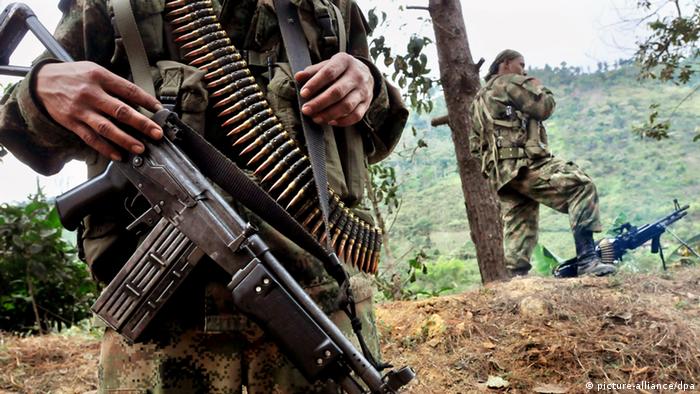
The historic armed conflict, which has
thought to have killed around 600,000 people in its nearly 50 year existence,
showed little sign of concluding as peace discussions in Havana between the two
broke-down, and the planned ceasefire came to an end.
In
a statement made to reporters, Iván Márquez, chief negotiator of The Revolutionary Armed Forces of Colombia (or
FARC), passed news of the breakdown of diplomacy. He said: "With pain in
my heart, we have to admit that we return to the stage of war that nobody in
this country wants."
The government, headed by President Juan Manuel Santos, had previously criticised the planned ceasefire, claiming that it only gave time for The Revolutionary Armed Forces of Colombia (FARC) time to re-supply and re-arm.
The government, headed by President Juan Manuel Santos, had previously criticised the planned ceasefire, claiming that it only gave time for The Revolutionary Armed Forces of Colombia (FARC) time to re-supply and re-arm.
However, the president conceded last
night that the two month spell had indeed been somewhat successful, as he told
reporters: "The fact is that the number of operations carried out by the
group decreased significantly; the number of police and soldiers killed or
injured decreased.
“There was a
relative compliance with the ceasefire."
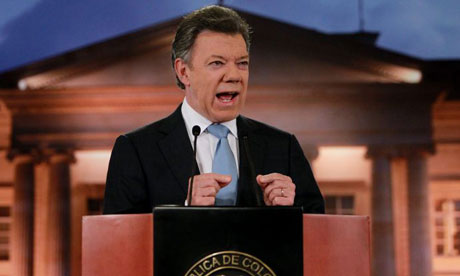 |
Colombian
president, Juan Miguel Santos
|
The lack of
solution suggests that the agrarian and anti-imperialist FARC will continue
their military operations against the perceived depredations of a right-leaning
government- as they have done since the conflict began in 1964.
Since that
time an aggressive campaign of kidnapping and alleged executions by FARC has
been met by an equally aggressive military presence throughout Colombia.
In recent
years FARC has witnessed the death of some of its key members at the hands of
the Colombian government, potentially contributing to their proposal of a
ceasefire in November last year; however, the guerrilla organisation is still
believed to have some 18,000 members across various parts of the country.
Meanwhile,
on the eve of talks between the two groups, the ELN (widely considered to be
the second largest militant group within Colombia, behind FARC) kidnapped five
mine workers in the south of the Bolivar province- including a Canadian and two Peruvian
nationals.
 |
Iván
Márquez meets with Venezuelan president Hugo Chávez in 2007
|
A Time for
Peace?
The government of Mr Santos will be
cautious in further peace talks between themselves and FARC. The rebel group
considers themselves a force for good in the liberation of the working-class,
and they have support.
The Marxist ideology is not belonging
to FARC, it is a legitimate political and social ideal popularised across the
South American region by Simón Bolívar and supported by countries such as
Venezuela- who have been important so far in their intermediary role between
FARC and the Colombian government.
A ceasefire has proved beneficial to
both parties, and indeed the population. Conflict between the two groups has
been limited to sporadic outbursts and they have not believed to have
significantly affected peace talks.
Equally, the Colombian government
should be as cautious of peace as they are of war. Even if time-tired by the
length of the conflict, FARC are not the only rebel group insistent on root
change. FARC may find, upon officially laying down their arms, that some of
their more militant members may simply join the ELN, or one of many other rebel
organisations.
Agreement on such heterogeneous political ideals is unlikely between the ruling government
and FARC, so the conflict is naturally not going to end soon. Peace talks
benefit both parties and they should be encouraged by Mr Santos. But peace is
not likely, and nor should it be taken lightly; after all, the Colombian
government could find the alternative to FARC (the enemy they know) less open
to such moments of relative peace. The motto of the ELN, “Liberation or Death”,
doesn’t suggest otherwise.

No comments:
Post a Comment